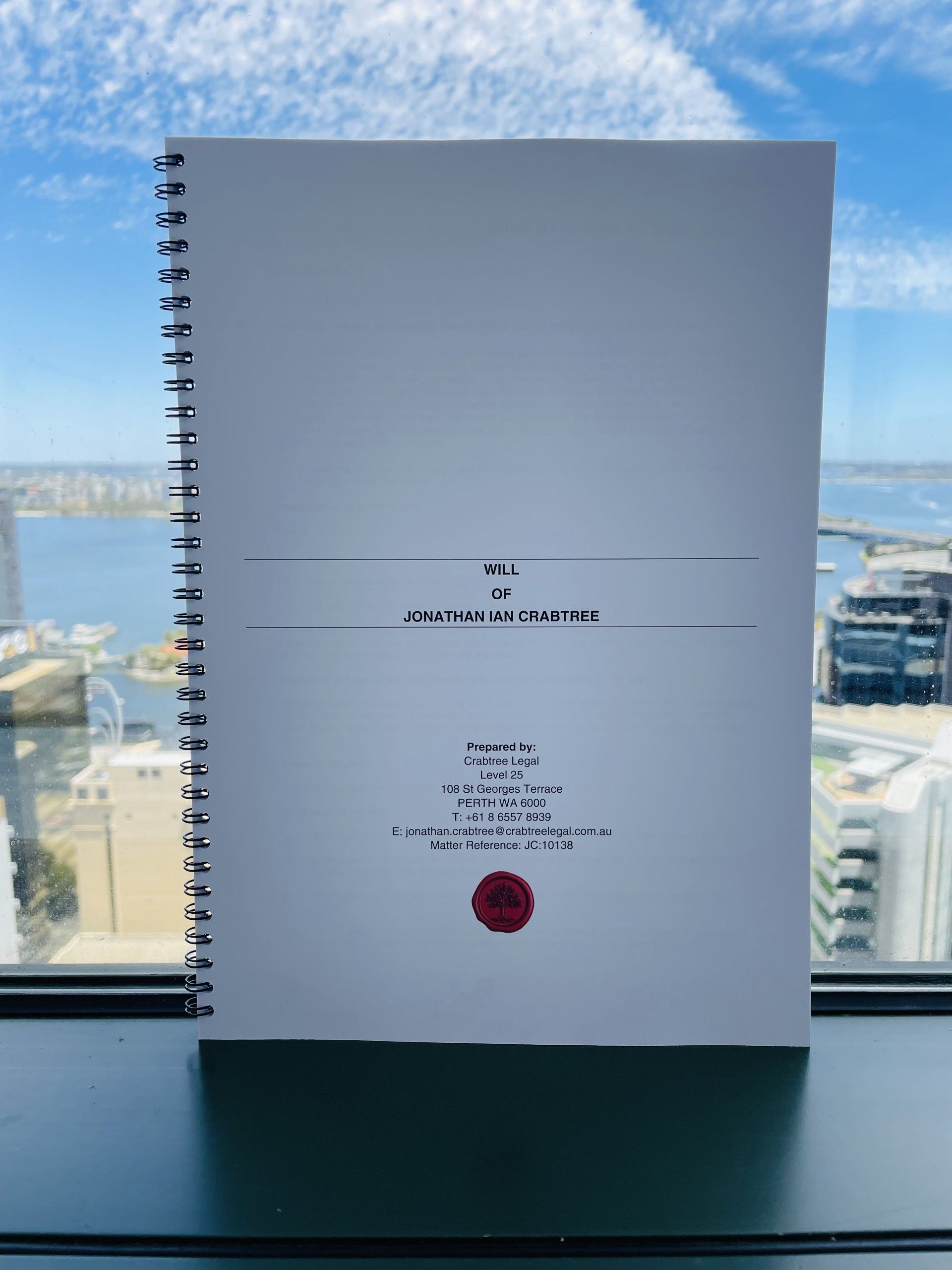
Why You Should Engage a Lawyer to Draft and Witness Your Will

August 12, 2025

When planning for your family's future, drafting a Will is one of the most important steps you can take to ensure your wishes are respected and your assets are distributed as intended. While online templates and DIY kits may seem convenient or cost-effective, there are significant risks associated with self-drafting your Will. Here's why working with a qualified lawyer—especially a veteran lawyer like Jonathan Crabtree Legal—is a wise investment in your family's security and peace of mind.


1. Legal Expertise Ensures Your Will is Valid


A Will that doesn’t meet legal requirements can be challenged in court or disregarded entirely. Lawyers have deep knowledge of the intricacies of wills, estate, and succession laws in Western Australia. By engaging a professional, you ensure your Will:


  • Meets statutory requirements for validity, including proper witnessing and execution.

  • Is worded clearly to avoid ambiguities or misinterpretations.


  • Anticipates future changes (such as marriage, divorce, or the birth of children).


2. Avoiding Costly Mistakes


DIY Wills commonly lead to errors, from incorrect signing procedures to omitted details about assets or beneficiaries. Such mistakes can result in:


  • Your Will being declared invalid.


  • Family disputes or litigation.


  • Unintended tax liabilities or missed opportunities for asset protection.


A an experienced estate planning lawyer will tailor your Will to your specific circumstances, ensuring all provisions are accurate and comprehensive.


3. Advice Beyond Simple Drafting


Every individual’s situation is unique. An experienced lawyer will provide guidance on estate planning strategies designed to protect your legacy, such as:


  • Testamentary trusts for children or vulnerable beneficiaries.


  • Business succession planning to secure your business interests.


  • Dealing with superannuation, trusts, and complex assets.


  • Reviewing Powers of Attorney and Guardianship to safeguard your interests if you lose capacity.


4. Proper Witnessing and Execution


Improper witnessing is a leading cause of invalid Wills in Australia. A lawyer will:


  • Ensure that your Will is signed and witnessed in accordance with the law.


  • Act as a professional witness, ready to defend the process should it be challenged.


  • Hold safe records for future reference.


5. Peace of Mind and Protection for Your Loved Ones


By entrusting your Will to an experienced estate planning lawyer, you protect your family from avoidable stress and conflict. Your lawyer can help anticipate problems, resolve ambiguities, and reduce the likelihood of challenges to your Will’s validity.


How Crabtree Legal Can Help


At Crabtree Legal, Jonathan Crabtree has extensive expertise in preparing straightforward and complex Wills, including those incorporating testamentary trusts, and Powers of Attorney and Guardianship. As a veteran owned and operated law firm based in Perth, WA, we pride ourselves on providing practical, empathetic advice tailored to your needs.


Contact us today to safeguard your legacy and give your loved ones security and peace of mind.

March 20, 2026
A new year is the perfect time to revisit an important question: is your Will still up to date? Many people make a Will once and then leave it untouched for years. But life rarely stays still. Relationships change, children are born, assets are bought and sold, businesses evolve, and family circumstances shift. A Will that once reflected your wishes may no longer do so. For that reason, reviewing your Will regularly is one of the simplest ways to protect the people and assets that matter most. Why people delay updating their Will It is easy to put off Estate Planning. Some people assume their Will is “good enough” because nothing dramatic has happened. Others feel uncomfortable thinking about what happens after they are gone. In practice, the most common reason Wills become outdated is not neglect in a dramatic sense, but everyday change. You may have: Married or separated. Had children or grandchildren. Bought property. Started or sold a business. Gained or lost significant assets. Named an Executor who is no longer suitable or available. If any of these apply, your current Will may need review. What can happen if a Will is outdated An outdated Will can create confusion, delay, and conflict at exactly the moment your family is already dealing with loss. It may also fail to reflect your real intentions. For example, assets may pass to someone you no longer intended to benefit, or a chosen Executor may no longer be the right person to manage the Estate. In some cases, the wording of an old Will can even create disputes that could have been avoided with a simple update. When to review your Will A good rule of thumb is to review your Will after any major life event, and otherwise every few years. You should consider an update if you have experienced: A marriage, divorce, or de facto relationship change. The birth or adoption of children. A death in the family. A major change in assets or liabilities. A move interstate or overseas. A change in your wishes about guardianship for your children, gifts, or Executors. Even if nothing major has changed, a periodic review helps ensure your instructions remain clear and legally effective. A simple process can prevent future problems Updating a Will does not have to be complicated. In many cases, a short review with a lawyer is enough to confirm whether the existing document still works or whether a new will is needed. A proper review can also identify related issues, including: Powers of attorney. Appointment of guardians. Superannuation nominations. Business succession arrangements. Asset ownership structures. These matters often work together, so an estate plan should be considered as a whole rather than as a single document. The takeaway The start of a new year is a useful reminder to get organised, and your Will should be part of that process. If your circumstances have changed, or if it has been several years since your last review, now is a sensible time to take another look. A current, well-drafted Will can save your family stress later and help ensure your wishes are carried out clearly.  Contact Crabtree Legal today for practical advice on updating your estate plan and protecting the people you care about most.
December 23, 2025
As we wrap up the year, we want to extend our heartfelt thanks to everyone who has supported Crabtree Legal since we commenced operations in May 2025. It’s been a privilege to serve our clients, collaborate with our partners, and begin building a legal practice grounded in integrity and community. We wish you and your loved ones a joyful Christmas filled with rest, connection, and gratitude. May the new year ahead be blessed with peace, purpose, and new opportunities. Thank you for being part of our journey. We look forward to supporting you in 2026. Warm regards, Jonathan Crabtree & the Crabtree Legal team
November 9, 2025
At Crabtree Legal, we understand that protecting your children’s inheritance from potential relationship breakdowns is a crucial concern for many families. The landmark Family Court of Australia decision in Bernard and Bernard [2019] FamCA 421 confirmed that testamentary trust Wills can be an effective tool in safeguarding a beneficiary’s inheritance from being divided upon divorce. Background of the Case In Bernard v Bernard, the husband’s late father created two discretionary testamentary trusts through his Will — one for his son and one for his daughter. The trusts operated as “mirror trusts”: each sibling was the trustee of the other’s trust but had no control over their own trust. The husband was the primary beneficiary of his trust, but the assets were legally owned and controlled by his sister as trustee. When the husband and wife later separated and divorced, the wife sought to have the husband’s inheritance held in the testamentary trust included in the matrimonial property pool for division. However, the husband argued that since he did not legally own or control the trust assets, and his interest was solely as a beneficiary dependent on the trustee’s discretion, the inheritance should be excluded from the property pool. Court’s Decision and Key Findings The Family Court ruled in favor of the husband, finding that the assets in the testamentary trust were not part of the matrimonial pool. The court’s key reasoning was that: The husband was not the settlor of the trust—the deceased father was. The husband had no legal ownership or control over the trust assets. The trustee (the husband’s sister) had complete discretion over income and capital distributions. The husband’s interest was discretionary and not guaranteed, meaning he could not compel distributions. The trust assets were inherited and not acquired during the marriage. This decision confirmed that a properly structured testamentary trust can protect a beneficiary’s inheritance from being divided upon divorce by separating legal ownership and control from mere beneficial interest. Why This Matters for Your Estate Planning Bernard v Bernard highlights how testamentary trust Wills can be used to safeguard your children’s inheritance from future relationship breakdowns, ensuring that inherited assets remain protected within the family and are not treated as divisible property in the event of a divorce. At Crabtree Legal, we specialise in Wills incorporating testamentary trusts and can provide tailored advice and drafting services to help you protect your family’s wealth across generations. Contact Crabtree Legal Today If you want to ensure your children’s inheritance is protected from a future divorce or relationship breakdown, contact Crabtree Legal today. We will guide you through establishing testamentary trust Wills that provide peace of mind and strong asset protection tailored to your family’s needs.